Description:
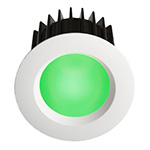
The RGBW surface-mounted spotlight impresses with its modern design and high luminosity. Whether it's rich colors for light accents or natural white light for basic lighting, this spotlight has it all! In contrast to classic recessed spotlights, these 24V LED spotlights are mounted on the surface or installed as stylish furniture lights.
Here you will find the 10 best tips for LED spots, free tools, tutorials, our lighting blog and many other Emilum services. We will support you with advice and assistance for your construction project as if it were our own!
Fields of application:
The RGBW surface-mounted luminaire exudes exclusive charm and can be used in particular when recessed spots are no longer possible due to the structure. Thanks to the modern design language of the LED luminaire, it can also be used as a striking design element in your interior design.
Technical features:
The LED spotlight with color change is rotatable and available in different designs made of high-quality aluminum. Particular emphasis was placed on a high color rendering index (value for color accuracy: CRI typ. 93) and excellent efficiency (light output: 107 lm/W).
Installation:
The spot is designed as a surface-mounted luminaire, which means that it can be retrofitted to ceilings or furniture at any time. First, the mounting disk is attached, then the 3 connections for tuneable white are connected and finally the lamp body is screwed on. True to the company motto: safe, simple, smart!
Controlling the spots:
the dimming and color control of the surface-mounted spotlight is just as easy as the installation. Four PWM channels of a 24V PWM dimmer are required for the colored LED spotlight. These can be used to continuously adjust both the brightness and the color temperature.
Other variants of surface-mounted spotlights:
This exclusive surface-mounted luminaire is also available as a warm white surface-mounted luminaire and as a tunable white surface-mounted spotlight in our extensive range.
If you also need recessed versions in addition to the RGBW surface-mounted spotlight, then you will find them in the RGBW spotlight category.